
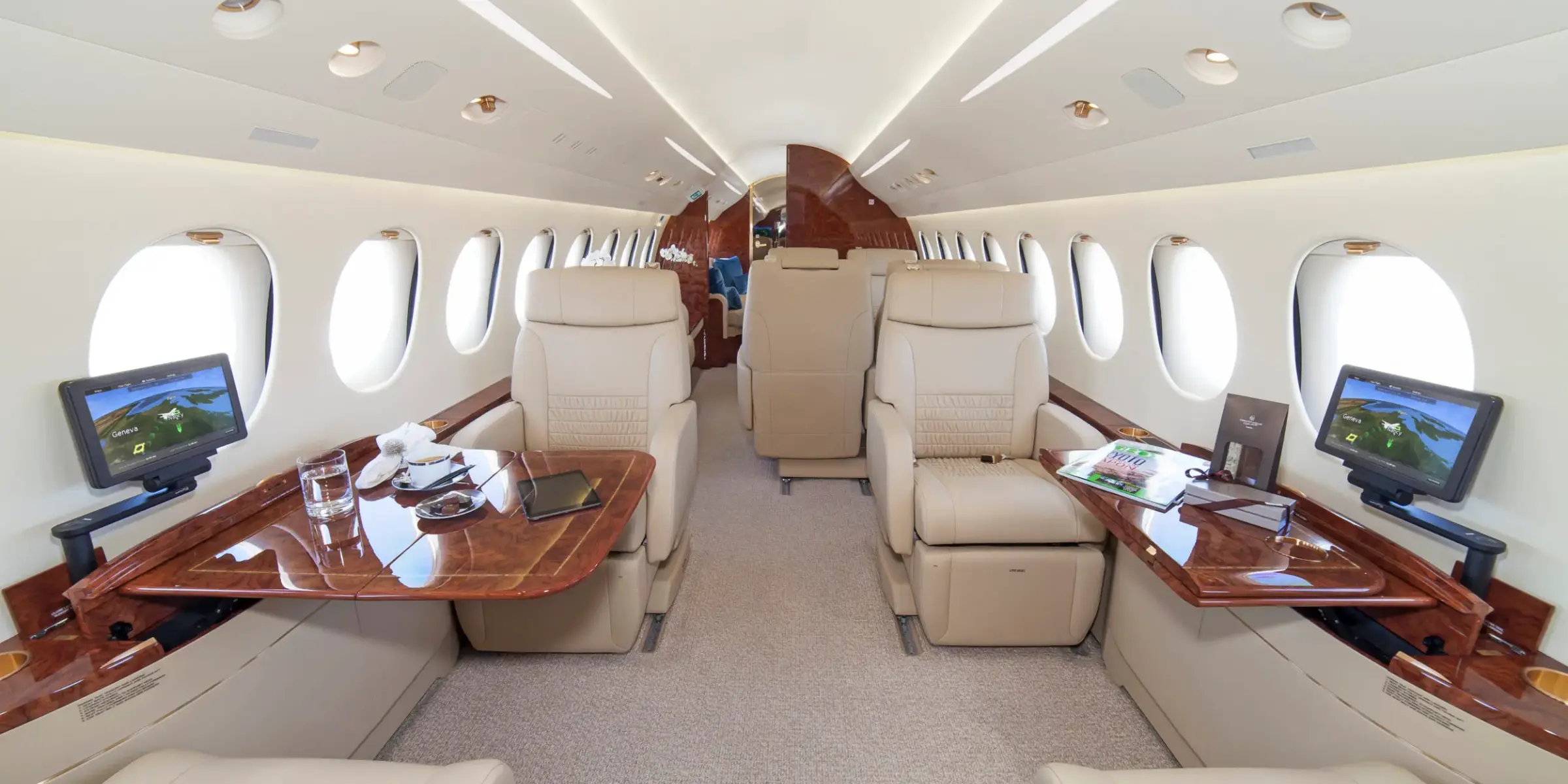
Air charter means hiring a complete aircraft, with its crew, for a given journey: you choose the destination, the date and the time, and the operator takes care of everything else. Unlike an airline ticket, you are not buying a seat on an existing flight: the flight is created for you. It is the most flexible form of business aviation, the one that turns the aircraft into a tool shaped to your diary, rather than the other way round.
How does an on-demand flight work?
Everything starts from your need: a route, dates, a number of passengers, sometimes particular constraints — a meeting at a precise hour, a maritime connection, a family trip. From there, the operator builds the flight: choice of aircraft suited to the distance and the number of passengers, appointment of the crew, flight plan, permits, ground handling at the departure and arrival airports, catering on board.
On the day of departure, the experience comes down to a few words: you arrive at the business aviation terminal a few minutes before the agreed time, the formalities are settled in complete discretion, and the aircraft takes off once you are on board. On arrival, your car can be waiting at the foot of the steps. The time gained is not limited to the flight itself: the whole chain of the journey is compressed.
We set out the complete course of a request, from the first call to take-off, in our article Booking a private jet.
What sets charter apart from other forms of private aviation?
Charter is paid for flight by flight, with no commitment of duration: that is its strength. It differs from ownership, which means buying and operating your own aircraft, and from intermediate formulas such as co-ownership or prepaid flight cards, which commit you over time.
For anyone flying a few dozen hours a year, charter is almost always the most rational answer: no capital tied up, no fixed costs, and an aircraft always suited to the day’s mission — a lighter aircraft for a European return trip, a long-range aircraft for a crossing. For anyone flying a great deal, the question of ownership arises, and we address it in our guide to aircraft management.
Who do you book your flight with: broker or operator?
It is the most important distinction in the sector, and the least known. The broker is an intermediary: it owns neither aircraft, nor crew, nor certificate, and resells flights operated by others. The operator holds an air operator certificate (an AOC, issued in Switzerland by theSwiss Federal Office of Civil Aviation), employs its crews and operates its aircraft under its own responsibility.
Booking with an operator means dealing directly with the party that performs the flight: responsibility is clear, information travels without an intermediary, and the crew that welcomes you belongs to the house you entrusted your journey to. The broker has its use for comparing the market; the operator offers the direct line. Checking that a provider holds an AOC is a simple reflex: the authorities publish the list of holders.
What can you expect from the service on board?
An on-demand flight is shaped the way a house shapes a stay. Catering adapts to your preferences, from a light tray to a full dinner; wines and drinks are chosen in advance; the cabin is configured according to the journey — working meeting, rest, family. Particular requests — a birthday on board, a specific diet, a flight with a pet — are prepared in advance with the operations team.
Discretion is part of the service just as much as comfort. Business aviation crews are trained to a simple rule: be present when you are needed, invisible the rest of the time. What you say, who is with you and where you are going is nobody’s business.
And the price — how is it built?
The price of a flight depends on the aircraft type, the destination, the availability of the aircraft, its positioning at the time of the request and the time it is to be made available. The quoted fare includes all the costs linked to the flight: the aircraft, the crew, the fuel, the airport charges, the organisation, the taxes and the service on board. We devote a complete article to what makes up a flight quotation: what it includes, and the rare charges billed separately.
Why charter with a Falcon specialist?
At Dasnair, charter rests on what has defined our house since 2001: a single aircraft family, the Dassault Falcon, operated under Swiss certificate, with crews and technicians dedicated to this type. Flying on an aircraft that its pilots and its engineers know intimately is the concrete definition of peace of mind. Our page Charter presents the service, and our operations study every request, day and night.
Frequently asked questions
How far in advance must you book?
A few days are enough in most cases, and faster departures remain possible depending on the availability of the aircraft and the permits required. The earlier the request, the wider the choice; but business aviation is made precisely to adapt to diaries that change.
Can a flight already booked be changed?
Yes, and it is one of the very advantages of on-demand flying. An earlier or later departure, an added stop, an extra passenger: operations recalculate the flight and confirm the adjustments to you. The exact conditions are set out at the time of booking.
Which airports are accessible by private jet?
Many more than by scheduled airline: business aviation reaches thousands of airfields, often as close as possible to your real destination. Some aircraft, such as the Falcon, even land on short or demanding runways inaccessible to most long-range jets.
Can I travel with a pet?
Yes, subject to prior agreement. Your pet travels in the cabin, at your side. The health regulations of the destination are checked in advance by operations: mention its presence as soon as you request the flight.
A journey to arrange? Send us your itinerary, your dates and the number of passengers: our operations answer around the clock on +41 22 717 82 00.
The Dasnair operations team · Updated: September 2026